
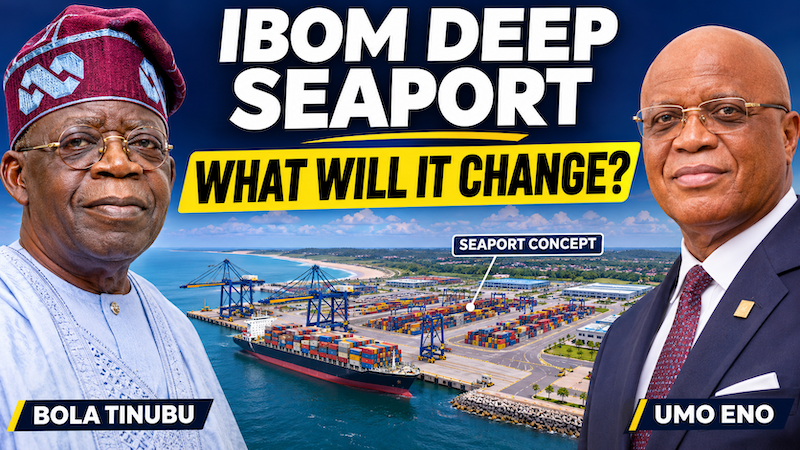
President Bola Tinubu has announced approval for the development of the Ibom Deep Seaport and reaffirmed his administration’s approval for international status at Victor Attah International Airport in Akwa Ibom State.
Speaking in Uyo on Friday, 6 November 2026, Tinubu said the proposed seaport would support investment and economic development. His remarks followed requests presented by Governor Umo Eno on behalf of the state, according to Voice of Nigeria.
Seaport Announcement at Uyo Rally
Tinubu addressed supporters at the Godswill Akpabio International Stadium during a political rally held as part of his visit.
Channels Television reported that Governor Eno sought federal support for delivering the seaport and pledged two million votes for Tinubu’s 2027 re-election bid.
The governor described the project as an investment capable of expanding economic opportunities across Akwa Ibom and the wider South-South region.
The announcement adds to a project that already had a history of federal approvals and preparatory work. The official Ibom Deep Seaport project website lists land acquisition, environmental assessment and business-case development among its milestones.
Airport Approval Predates the Visit
Tinubu also confirmed that he had previously approved the state’s request for international airport status.
During the inauguration of the new terminal, he praised continuity between successive state administrations and Governor Eno’s commitment to completing the aviation project, The Guardian reported.
The airport approval therefore predates Friday’s announcement. In his 2026 New Year address, Eno had already thanked the President for granting international status to the facility.
Infrastructure and Economic Priorities
Voice of Nigeria reported that the visit included the inauguration of the airport’s international terminal, hospital and Ibom Aviation Village.
Tinubu also highlighted education, practical skills, employment and oil palm development as priorities. He encouraged young Nigerians to obtain their Permanent Voter Cards and participate in elections.
The Presidency’s itinerary had listed additional road, administrative and tourism projects for inauguration during the visit. These included Airport–Okopedi Road, Ring Road 3, the AKWA-GIS Office Complex and ARISE Palm Resort.
The seaport announcement represents presidential backing for the project; it should not be confused with confirmation that construction is complete or commercial operations have begun.
Economic Impact on Akwa Ibom State
1. Jobs and opportunities for local businesses
Construction could create demand for engineers, technicians, construction workers, transport operators and suppliers.
Once operational, the seaport could support cargo handling, warehousing, freight forwarding, security and maintenance. Airport activity could increase demand for hospitality, catering, ground handling and passenger transport.
Local people benefit most when contracts include practical training and opportunities for qualified local suppliers. Construction jobs are temporary; lasting employment depends on sustained business activity.
2. More investment in factories and processing
The port is planned alongside Ibom Industrial City and a free trade zone. This could encourage companies to locate processing plants and warehouses near shipping facilities. The project’s official plans identify the port and industrial development as linked investments.
For example, a business could process agricultural produce in Akwa Ibom, package it locally and export the finished product. That would retain more economic value than selling unprocessed produce.
However, factories also need reliable electricity, water, skilled workers and predictable regulation.
3. Better access to markets for farmers and producers
A functioning port could give eligible exporters another route to overseas markets. Air cargo could serve suitable high-value or time-sensitive products where the necessary services exist.
Akwa Ibom’s investment plans identify opportunities involving agriculture, petrochemicals, freight and courier services. These are development opportunities, not confirmation that export supply chains are already operating.
Farmers would still need buyers, consistent quality, processing, storage and compliance with destination-country standards.
4. More visitors and business travel
Reliable international flights could make Akwa Ibom easier to reach for investors, tourists and Nigerians living abroad.
More visitors could increase spending at hotels, restaurants, shops, attractions and event venues. But international airport status does not automatically attract airlines: routes need sufficient passenger demand and commercially viable operating conditions.
The state government identifies connectivity, tourism and investment as intended benefits of the airport’s international designation.
5. A broader state revenue base
More businesses and formal employment could increase state revenue through applicable taxes and charges.
However, customs duties collected at a seaport are federal revenue—not automatically Akwa Ibom State revenue. The state’s direct financial returns would depend on its ownership, investment agreements and lawful revenue arrangements.
Free-zone incentives also mean that increased activity may not immediately translate into large tax receipts.
Economic Impact on Nigeria
6. Additional port capacity and transport options
Ibom could provide another gateway for importers and exporters, particularly where its location offers a practical advantage.
The Infrastructure Concession Regulatory Commission describes the proposed port as an additional national and regional cargo gateway.
A useful alternative could reduce dependence on particular ports. It could also encourage competition over service quality and charges.
Lower transport costs are possible, but not automatic. Businesses will compare shipping frequency, terminal charges, customs delays and the cost of moving goods inland.
7. Greater non-oil export earnings
If the infrastructure helps Nigerian businesses export more processed goods and services, it could generate foreign-exchange earnings and broaden the economy beyond crude oil.
The important distinction is between creating new production and merely moving existing cargo from one Nigerian port to another. New exports and manufacturing produce stronger national gains than traffic relocation alone.
8. Aviation maintenance and technical skills
The airport’s Maintenance, Repair and Overhaul facility could support skilled employment and retain some expenditure that airlines otherwise make abroad.
That depends on certification, technical capability, equipment, spare-parts supply and airline contracts. A building alone cannot deliver aircraft-maintenance services.
The state has pursued an operating partnership intended to strengthen the facility’s technical capacity and local aviation workforce.
9. Regional shipping business
The port’s proposed transshipment role could attract cargo that is transferred between large vessels and smaller ships serving other destinations.
If commercially competitive, this could bring service earnings to Nigeria. However, shipping companies choose ports based on reliability, cost, location and connections—not approval announcements alone. The project website describes this intended regional role.
Costs and Risks That Must Be Managed
| Issue | Economic consequence |
|---|---|
| Expensive borrowing or public guarantees | Debt and repayment obligations could outweigh returns if usage disappoints. |
| Weak roads and inland connections | Cargo delays could erase the port’s location advantage. |
| Insufficient customers | Underused terminals and facilities could require continuing subsidies. |
| Land acquisition and environmental damage | Communities could lose livelihoods or face costs that require prevention, compensation and restoration. |
| Weak local participation | Investment could grow while much of the income goes outside the state. |
| Poor management or procurement | Delays, cost overruns and unreliable services could discourage investors. |
For an ordinary Akwa Ibom resident, the practical benefit would be more dependable work, stronger demand for local products and better business opportunities. For Nigeria, it would be additional productive capacity, competitive logistics and export earnings. The strongest test of success will be actual operations, sustainable jobs and returns after costs—not the size of the announcement.